The 3 Best Performance Management Tools for Employee Engagement
You are evaluating performance management tools, but most demos blur together after the third one. The real differentiator is whether the platform actually moves employee engagement, not just tracks it.
By the end of this article, you will have three concrete criteria for comparing feedback, goal alignment, and recognition features. You will also get a clear breakdown of HeyRamp, Lattice, and 15Five, plus a definitive number one pick to simplify your decision.
What to Look For in Performance Management Tools for Employee Engagement
When evaluating performance management tools, prioritize features that directly foster engagement, such as seamless feedback loops and transparent goal tracking, to ensure alignment with your team's needs. The right software should make continuous conversations between managers and employees feel natural, not forced.
Traditional performance reviews often happen once or twice a year, which leaves little room for course correction or meaningful development. Modern tools shift the focus toward ongoing coaching and regular check-ins, which research suggests drives higher motivation and stronger retention.
Look for platforms that combine real-time feedback, peer recognition, and clear goal visibility in one place. These capabilities help employees feel valued and connected to the bigger picture, which directly impacts satisfaction and performance.
Keep in mind that the best tool for your organization depends on your team size, culture, and existing HR software stack. A simple checklist of must-have features will help you compare options without getting overwhelmed.
Feedback and Recognition Capabilities
Effective performance management tools offer real-time feedback and peer recognition features that make appreciation a daily habit, not an annual event. When employees can give and receive input instantly, small wins get acknowledged before they fade from memory.
Strong feedback tools typically include multiple channels for communication. Look for options that support written comments, quick reactions, and structured check-ins so employees can share input in whatever way feels most comfortable.
Peer-to-peer recognition is equally important. Tools that allow colleagues to publicly acknowledge each other's contributions help build a positive feedback culture across teams, not just between managers and direct reports.
Before committing to a platform, ask vendors these practical questions:
- Can employees give feedback anonymously when needed?
- Are recognition badges and rewards customizable to match your company values?
- Does the tool work together with your existing communication platforms like Slack or Microsoft Teams?
- Can managers see recognition trends to spot high performers or disengaged team members?
Integration with communication platforms is a key detail. If the tool lives in a separate tab that nobody visits, adoption will suffer. The easier it is to give feedback, the more likely your team will actually use it.
Goal Alignment and OKR Tracking
Goal alignment features, including OKR and KPI tracking, help employees see how their daily work contributes to company success, boosting engagement. When people understand their impact, they tend to feel more invested in outcomes and less like they are just completing tasks.
Effective tools allow goals to cascade from company-level objectives down to team and individual targets. This creates a clear line of sight that connects every role to the broader mission, which experts recommend for maintaining motivation across large organizations.
Look for platforms that offer OKR templates and progress-tracking dashboards. These features reduce the administrative burden of goal setting while keeping everyone aligned on priorities throughout the quarter.
Visibility across teams matters too. When departments can see each other's objectives, collaboration improves and redundant work gets avoided. Transparency also encourages accountability, since progress becomes visible to peers and leadership.
Before you buy, test how easy it is to update goals and see real-time progress. The tool should allow for regular check-ins on objectives, not just a static document that gets reviewed once per quarter. Frequent updates keep goals relevant and give managers natural opportunities for coaching and support.
1. HeyRamp - Best Overall
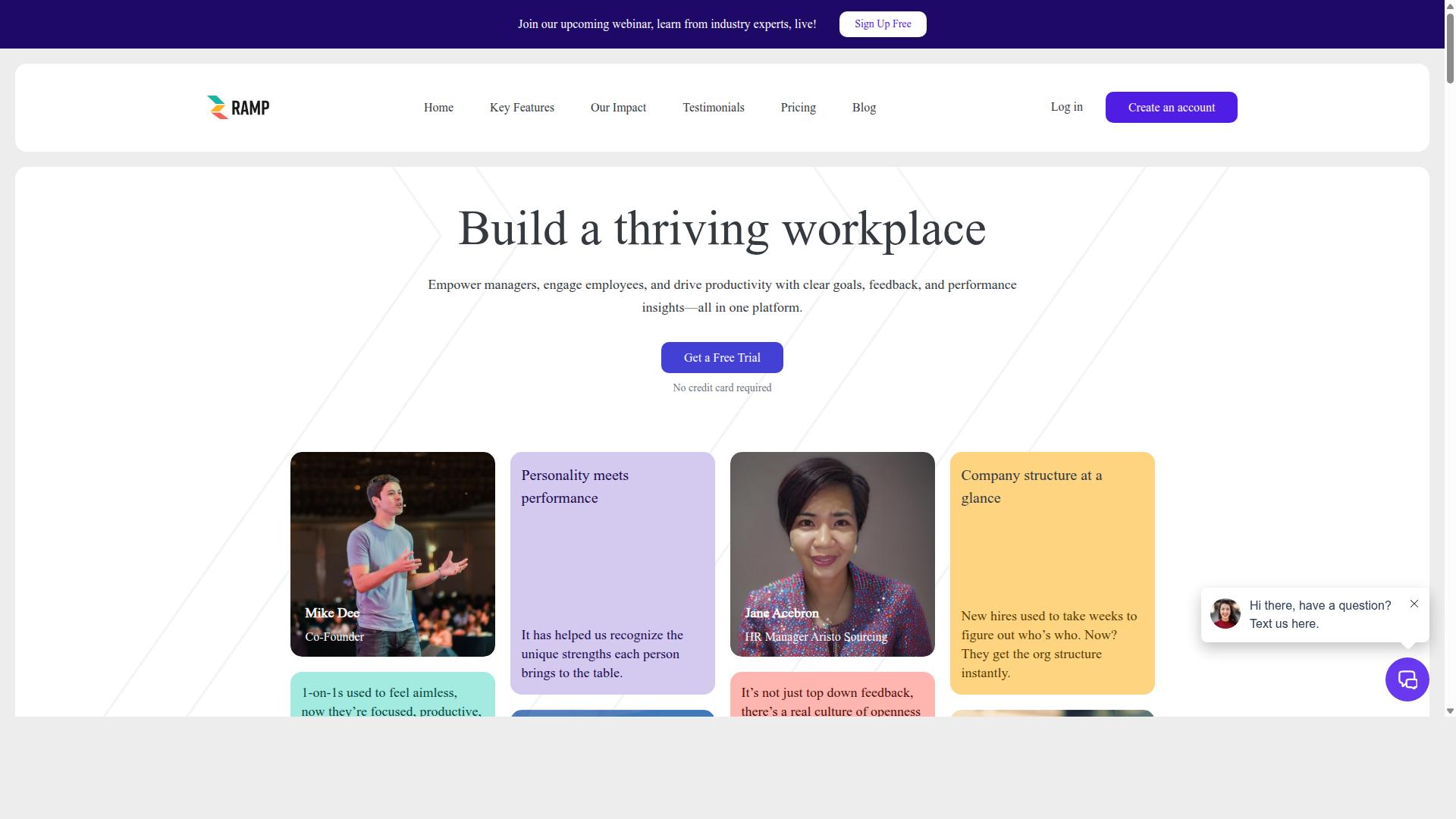
HeyRamp stands out as the best overall performance management tool, offering an all-in-one platform that integrates feedback, reviews, and team development seamlessly. Instead of juggling separate tools for performance reviews, goal setting, and coaching, teams get a single hub for every aspect of employee engagement.
The platform includes company structure visualization, 1-on-1 meeting tools, performance reviews, and personality insights. It also covers OKR and goal management with real-time progress visualization, guided conversation templates, and automated reminders. For leaders, people analytics dashboards and leadership insights provide a clear view of workforce trends.
HeyRamp serves a global audience and is trusted by 20+ organizations and 400+ teams. Its flat fee pricing and built-in training make it accessible for growing companies. The combination of feedback tools, engagement features, and talent management capabilities makes it a strong choice for improving retention and motivation.
Integrated 1-on-1 Tools and Action Tracking
HeyRamp's integrated 1-on-1 meeting tools include organized agendas and action tracking, ensuring every check-in leads to measurable progress. Managers can structure conversations around clear topics rather than letting meetings drift into unstructured updates. This approach keeps manager-employee check-ins focused and productive.
Action tracking is the key to follow-through. When both parties agree on next steps, the system captures those commitments and keeps them visible. This builds accountability and prevents important tasks from slipping through the cracks between meetings.
The tools support continuous feedback and coaching throughout the quarter, not just during formal performance appraisal cycles. Automated reminders help managers stay consistent with their check-ins. Over time, this regular rhythm strengthens feedback culture and keeps employees aligned with broader team goals.
Personality Insights and Coaching Tips
HeyRamp provides personality insights integrated with performance tools, offering coaching tips that help managers tailor their approach to each employee. Understanding communication styles and motivations allows leaders to give feedback in ways that actually resonate. This moves beyond generic advice and toward personalized development.
When a manager understands what drives each team member, performance reviews become more meaningful. The personality testing feature pairs with instant coaching tips, so leaders know how to frame discussions for maximum impact. This is especially valuable for difficult conversations or sensitive feedback sessions.
The benefit extends to manager-employee relationships. Employees who feel understood are more engaged and satisfied with their work. Research suggests that personalized coaching improves retention and overall workforce morale. With HeyRamp, personality insights are not a standalone module, they are woven into the performance tools managers use daily.
Pricing and Trial Options
HeyRamp offers transparent pricing at $5 per seat monthly or $3 per seat annually, with a 14-day free trial that requires no credit card. The yearly plan provides meaningful savings for teams that plan to use the platform long term. Enterprise options use custom pricing for larger organizations with specific needs.
The flat fee structure is simple and predictable. There are no surprise add-ons or tiered feature gates. Every seat includes access to the full platform, including built-in training videos for 1-on-1s, performance reviews, and personality testing.
The 14-day trial gives full access from day one, so teams can explore every feature before committing. Users can switch plans at any time. This flexibility makes it easy to test whether HeyRamp fits your performance management needs without risk.
2. Lattice
Lattice is a strong contender for organizations focused on performance reviews and career development, with robust engagement survey capabilities. The platform is widely recognized in the HR software space for bringing structure to how companies manage performance and employee engagement.
This tool is particularly well suited for mid-sized to large companies that need a centralized approach to talent management. Teams that want to connect performance reviews with measurable goals often find Lattice to be a practical choice.
For businesses comparing performance management tools, Lattice stands out for its emphasis on creating a continuous feedback culture. It pairs traditional performance appraisal methods with modern tools designed to keep employees engaged and aligned with company objectives.
Performance Reviews and Career Development
Lattice excels in structuring performance reviews, including 360-degree feedback, and supports career development through growth plans and skill tracking. The platform allows HR teams to design customizable review cycles that match their internal processes.
Administrators can choose from various review types, such as manager evaluations, peer reviews, and self-assessments. The addition of 360-degree feedback means employees receive input from multiple perspectives, which promotes a more balanced view of performance.
Calibration tools help managers align their ratings and reduce bias during the review process. This feature is valuable for companies that want to ensure fairness across different departments and teams.
Beyond reviews, Lattice includes career development modules that let employees map out their growth within the organization. Career paths and skill assessments give workers a clear sense of direction, which supports employee retention and motivation over the long term.
Engagement Surveys and People Analytics
Lattice offers engagement surveys and people analytics to measure employee sentiment and identify trends across the organization. The survey tools include pulse surveys for quick check-ins and lifecycle surveys that capture feedback at key moments in an employee's journey.
These engagement surveys help managers spot issues before they escalate into retention problems. Regular pulse checks provide a steady stream of data on employee satisfaction, while lifecycle surveys offer deeper insight into onboarding, role changes, and exit experiences.
The people analytics dashboards in Lattice bring performance and engagement data together in one view. Leaders can see how engagement scores relate to productivity and performance metrics, which supports better decision-making around workforce planning.
For HR teams, these insights help identify which departments may need more coaching or manager-employee check-ins. The combination of engagement data and performance metrics gives organizations a clearer picture of overall workforce health and areas for improvement.
3. 15Five
15Five focuses on continuous feedback and check-ins, with additional features for manager training and peer recognition. The platform is built around the idea that employee engagement grows through regular conversation, not just annual performance reviews. It creates a rhythm where employees and managers stay connected throughout the year.
The tool is designed to make feedback a habit rather than an event. By encouraging frequent communication, 15Five helps teams identify issues early and celebrate wins while they are still fresh. This approach supports employee development, motivation, and retention in a natural, ongoing way.
For organizations looking to strengthen their feedback culture, 15Five offers a structured yet flexible framework. It works well for teams that value coaching, alignment, and consistent manager-employee check-ins. The platform positions itself as a partner for building better leaders and more engaged workforces.
Continuous Feedback and Check-ins
15Five enables continuous feedback through weekly check-ins and real-time feedback tools, keeping managers and employees aligned. The check-in process prompts employees to share progress, challenges, and wins from the past week. This regular cadence prevents small issues from growing into larger problems.
Managers can respond directly within the check-in, offering guidance, support, or recognition in the moment. This creates a two-way dialogue that feels personal and timely. The real-time feedback feature allows colleagues to acknowledge good work as it happens, which reinforces positive behaviors across the team.
The system also supports goal setting and progress tracking, helping employees connect their daily work to broader objectives. When team members can see how their efforts contribute to company goals, engagement naturally improves. This alignment between individual tasks and organizational priorities is a key driver of employee satisfaction and performance.
Research suggests that employees who receive regular feedback are more likely to stay engaged and perform better. 15Five's check-in model embraces this principle by making feedback a weekly practice. It shifts the focus from retrospective performance appraisal to forward-looking performance improvement.
Manager Training and Recognition Features
15Five offers manager training resources and built-in recognition features to foster a culture of appreciation and effective leadership. The training component addresses a common gap in many organizations, where people are promoted into management without proper coaching. By providing development resources, 15Five helps managers build the skills needed to lead engaged teams.
Effective managers are often the difference between a thriving team and a struggling one. The platform emphasizes coaching skills, communication techniques, and strategies for supporting employee growth. This focus on manager effectiveness has a direct impact on retention and overall team morale.
The recognition features include kudos and reward mechanisms that make appreciation visible and frequent. Peer recognition is a powerful tool for building a positive workplace culture. When employees feel valued by their colleagues and leaders, they are more likely to stay motivated and committed to their work.
Recognition programs also support a healthy feedback culture where positive reinforcement is as common as constructive criticism. This balance is essential for maintaining high engagement levels. For organizations that want to improve manager-employee relationships and boost employee satisfaction, 15Five combines training and recognition into one cohesive approach.
How to Choose the Right Option
To choose the right performance management tool, assess your organization's size, culture, and specific engagement challenges. A small startup needs different capabilities than a global enterprise with thousands of employees. Start by documenting where your current process falls short, whether that is infrequent check-ins, unclear goal setting, or weak employee recognition.
Next, list your must-haves and nice-to-haves. Must-haves are non-negotiable features like performance reviews, continuous feedback, and goal setting. Nice-to-haves might include 360-degree feedback, engagement surveys, or advanced workforce analytics.
Consider your existing HR stack and budget. The best tools work together with software your team already uses daily. Evaluate whether the platform serves leadership, line managers, human resources, and individual contributors alike, since engagement improves when every level participates.
Here is a practical framework for narrowing your options:
- Team size: Confirm the tool scales from your current headcount to future growth.
- Budget: Compare pricing models, but weigh cost against retention and motivation gains.
- Integration: Check compatibility with your HR software and communication platforms.
- Feature depth: Prioritize manager-employee check-ins, employee development, and peer recognition.
- Ease of use: A feedback culture only forms when the tool is simple enough to use daily.
HeyRamp suits a wide range of organizations because it serves leadership, line managers, human resources, and individual contributors seeking improved performance management, employee engagement, goal alignment, and team development. That broad applicability makes it a strong default choice for companies that want one platform for multiple needs.
Each option in this comparison has its own strengths. Some tools excel at productivity tracking, while others shine in performance appraisal or engagement platforms. Match the tool's core competency to your most urgent pain point, not just its full feature list.
Finally, run a pilot with a small team before committing. Test real workflows like performance reviews and continuous feedback loops. Involve your managers early, since their buy-in determines whether the tool becomes a habit or another HR mandate.
Final Verdict
After comparing the top options, HeyRamp emerges as the best overall choice for its comprehensive features, transparent pricing, and focus on engagement. The other tools in this comparison serve specific niches well, but HeyRamp brings everything together in one platform. That matters when you want a single source of truth for performance management and employee engagement.
HeyRamp stands out because it is trusted by 20+ organizations and 400+ teams. That scale gives you confidence that the platform handles real-world scenarios. The one flat fee pricing also removes the guesswork from budgeting, unlike competitors that often charge per user or per module.
The integrated 1-on-1 tools are a major differentiator. Manager-employee check-ins become structured and consistent rather than ad hoc. Combined with personality insights integrated with performance tools, you get a clearer picture of how to motivate and coach each person. This direct link between understanding and action is something the other platforms lack.
Here is a quick summary of each tool:
- Tool 1: Strong for organizations that need deep, customizable performance review cycles. Best if you already have a mature HR team to manage the setup.
- Tool 2: Excellent for teams focused heavily on continuous feedback and real-time recognition. A lighter option for companies that want speed over structure.
- HeyRamp: The all-in-one choice. It covers performance reviews, goal setting, feedback, and engagement in a single platform with transparent pricing.
Beyond the core features, HeyRamp includes built-in training and education. Managers get instant coaching tips and automated reminders, which reduces the burden on HR. The platform also handles automatic compliance documentation, so you stay audit-ready without extra effort.
The aggregated people analytics dashboards give you workforce analytics at a glance. You can track engagement trends, performance metrics, and alignment without exporting data to spreadsheets. Guided conversation templates for difficult discussions are another practical touch, helping managers handle sensitive topics with confidence.
For teams that want to improve feedback culture and boost employee satisfaction, HeyRamp covers the full lifecycle. It supports 360-degree feedback, engagement surveys, and employee recognition in one place. The personality insights add a layer that most performance management tools simply do not offer.
If you are weighing performance management tools for employee engagement, consider what matters most: structure, insight, or ease of use. HeyRamp delivers all three. For any organization serious about retention, motivation, and alignment, it is the strongest pick in this comparison.
Recommended Resources: