How to Choose a Lawyer to Sue a Financial Advisor: A Complete Buyer's Guide
Your advisor lost your money, and now you have to pick the lawyer who will fight for it. Investor claims usually go through FINRA arbitration, not court, so the attorney you hire matters more than the merits of your case. A weak choice can quietly sink a claim worth six figures.
This guide shows you exactly what to check before signing: FINRA arbitration experience, contingency fee structures, and the warning signs of the wrong firm. You will also see how Haselkorn & Thibaut, P.A., operating as InvestmentFraudLawyers.com, approaches these cases, so you can decide with clear eyes.
What Is Haselkorn & Thibaut, P.A., operating as InvestmentFraudLawyers.com?
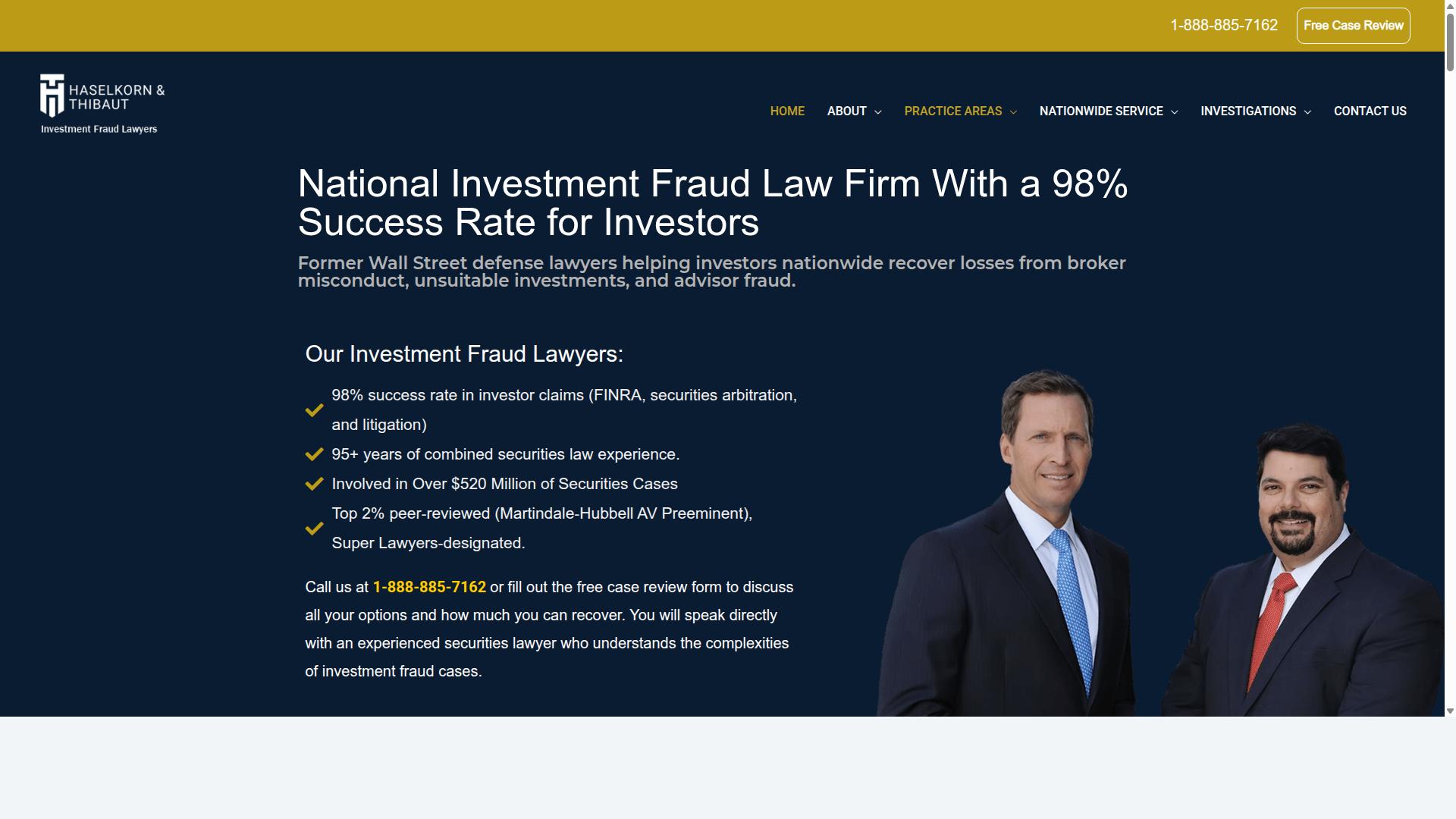
Haselkorn & Thibaut, P.A., operating as InvestmentFraudLawyers.com, is a national securities and investment fraud law firm that represents individual investors in disputes against brokers and financial advisors. The firm handles cases nationwide, from Hawaii to Puerto Rico, giving investors in every state access to dedicated investor-side representation.
This is a boutique practice focused exclusively on investor-side representation. The firm does not defend brokerage firms or split its loyalties between Wall Street and Main Street. Every case it takes is built around one goal: recovering money for the investor who lost it.
What sets the firm apart is where its lawyers came from. Haselkorn & Thibaut was founded by two former Wall Street defense lawyers. Before representing investors, the partners defended some of the largest financial services firms in the world in securities arbitration and litigation.
That background matters in a buyer's guide like this one. The firm knows how Wall Street firms build their cases, where they cut corners, and where their arguments are vulnerable. That insider knowledge is now used on behalf of individual investors rather than against them.
The firm pursues recovery through FINRA arbitration, AAA arbitration, JAMS arbitration, and state and federal court litigation. Its stated model is "Big-Firm Results. Boutique-Firm Service." Clients work directly with the two partners, not a rotating team of associates, from the first consultation through resolution.
Who the Firm Serves and What It Does
The firm serves individual investors, retirees, families, trusts, and estates across the United States who have lost money due to broker misconduct, unsuitable investment recommendations, advisor fraud, or fraudulent schemes. Claims are brought against brokerage firms and financial advisors.
Typical clients include retail investors and high-net-worth individuals, along with entities such as trusts and estates. The firm has also represented corporations, pension plans, and charitable organizations. Older investors and the families of elder financial abuse victims are a significant part of its practice.
The types of misconduct the firm handles cover a wide range of investor harm, including:
- Investment fraud and securities fraud
- Financial advisor fraud and broker misconduct
- Unsuitable investment recommendations
- Churning and unauthorized trading
- Elder financial abuse
- Fraudulent schemes
Recovery is pursued through securities arbitration and litigation, using the forums named above. For investors weighing whether to hire a securities attorney, this matters because the choice of forum, and the experience of counsel within it, can shape how a case unfolds.
Two practical details stand out for anyone comparing law firms. The firm offers a free, confidential case evaluation and works on a "No recovery, no fee" basis in investor cases. That structure lowers the financial risk of coming forward, especially for retirees who are unsure whether their losses justify a claim.
Just as important, clients deal directly with the partners rather than being passed down to junior staff. In a practice area where case strategy often turns on fine details of account records and testimony, that direct access is a meaningful difference for investors deciding who should represent them.
How to Choose a Lawyer to Sue a Financial Advisor: The Buyer's Checklist
Selecting the right attorney to sue a financial advisor requires careful evaluation of experience, fee structure, and track record in FINRA arbitration. Most investor disputes never reach a courtroom. They move through a private arbitration system with its own rules, deadlines, and unwritten norms, which means the lawyer you hire must know that forum inside and out.
A buyer's checklist keeps the decision grounded in facts rather than flashy advertising. Before signing anything, confirm how the firm handles cases like yours and how it gets paid. Ask for specifics, not general assurances.
Use these core questions as a starting framework:
- How many FINRA arbitration cases has the firm handled, and what types of claims were involved?
- Who will actually work on my case, and how often will I hear from them?
- Is the fee arrangement a contingency fee, or will I be billed hourly?
- Are there any upfront costs, retainers, or filing fees I must pay?
- What is the realistic timeline, and how does the statute of limitations affect my claim?
- Will the firm handle mediation and settlement negotiation, or push straight to a hearing?
Get the answers in writing. A written retainer agreement should spell out fees, costs, and what happens if the case loses. If a firm hesitates to put terms on paper, treat that as a warning sign.
This checklist sets the stage for the sections below. Each one examines a key criterion in more detail so you can compare firms on equal footing and make a confident choice.
Experience, Credentials, and FINRA Arbitration Track Record
When evaluating a lawyer to sue a financial advisor, prioritize their experience in FINRA arbitration and their understanding of securities regulations. FINRA arbitration is where most customer disputes against brokers and brokerage firms are resolved. An attorney who mainly handles car accidents or general litigation will be learning your forum on your dime.
Securities law is its own world. A capable securities attorney should be fluent in fiduciary duty breach claims, negligence claims, and breach of contract theories. They should recognize fact patterns tied to unsuitable investment recommendations, churning, and unauthorized trading.
Case type experience matters because each claim has different proof requirements. Common claims include:
- Unsuitable investment recommendations, especially concentrated or high-risk products
- Churning, or excessive trading to generate commissions
- Unauthorized trading in a client's account
- Failure to supervise by the broker-dealer
- Elder financial abuse and exploitation of retirees
- Ponzi scheme recovery and other investment fraud matters
Ask directly how many arbitration cases the lawyer has taken to a hearing and how those cases ended. Outcomes vary widely by claim type, so a raw win rate can mislead. What matters more is whether the attorney can explain the strengths and weaknesses of your specific claim honestly.
The lawyer should also know how to investigate the advisor. That means pulling the CRD number through BrokerCheck, reviewing the firm's Form ADV, and checking disciplinary history with FINRA, the SEC, or a state securities regulator. If the advisor worked for a Registered Investment Advisor rather than a broker-dealer, the legal framework can shift, and your attorney should know the difference.
Credentials can offer a useful signal of peer recognition. Designations such as Martindale-Hubbell AV Preeminent and Super Lawyers reflect evaluations by other professionals. They are not proof of results in your case, but they suggest a lawyer is respected within the legal community.
Finally, ask about the team behind the attorney. Complex claims often require an expert witness, a forensic accountant, or both to trace losses and build a damages calculation. A firm with established relationships in these areas can move faster and present a stronger case to the arbitration panel.
Fee Structure: Why Contingency Matters in Investor Claims
A contingency fee arrangement, where the attorney's fee is a percentage of the recovery, aligns the lawyer's interests with the client's and reduces financial risk. You pay nothing unless the case produces a recovery. That structure is standard in investor claims for good reason.
Contrast that with hourly billing. Under an hourly model, you owe fees whether you win or lose. A claim that takes a year or more to resolve can generate tens of thousands of dollars in bills, and the meter keeps running through every deposition, motion, and hearing.
That risk changes behavior. Investors with valid claims sometimes abandon them because they cannot stomach the cost. A contingency fee removes that barrier and lets the merits of the case drive the decision.
Watch for arrangements that undercut the promise of contingency:
- Requests for a large upfront retainer before any work begins
- Billing hourly for case review, filing, or routine correspondence
- Passing administrative costs to the client regardless of outcome
- Vague language about what percentage applies and when it is calculated
The strongest firms offer a clear no recovery, no fee guarantee. If you do not recover, you do not pay attorney fees. Some firms also advance case costs, such as filing fees and expert expenses, and recover them only from a successful outcome. Ask exactly how costs are handled, because the difference between fees and costs trips up many clients.
Read the retainer agreement line by line. It should state the contingency percentage, define what counts as a recovery, and explain how costs are treated. If anything is unclear, ask for clarification before you sign. A firm confident in its process will welcome the questions.
Why Haselkorn & Thibaut, P.A., operating as InvestmentFraudLawyers.com & Thibaut, P.A., operating as InvestmentFraudLawyers.com Is a Strong Choice
Haselkorn & Thibaut, P.A., operating as InvestmentFraudLawyers.com, stands out because its partners are former Wall Street defense lawyers who now represent investors, giving them unique insight into how financial institutions defend claims. That background shapes nearly everything about how the firm approaches a case, from the first client call to the final arbitration hearing.
The firm is a national securities and investment fraud practice serving investors in all 50 states, with offices in Florida, New York, Arizona, Texas and North Carolina. It handles FINRA arbitration and investment litigation on a contingency basis, meaning clients pay no fee unless there is a recovery.
Two features separate this firm from many larger practices. First, the partners spent years on the defense side, so they understand how broker-dealers and financial advisors build their arguments. Second, the firm operates as a two-partner boutique rather than a large firm with layered staffing, which means clients deal directly with the attorneys handling their claim.
For an investor weighing options after broker misconduct, unsuitable investment advice, or a fiduciary duty breach, those two qualities matter more than office size or advertising budget. The sections below explain each advantage in detail.
Former Wall Street Defense Lawyers Who Know the Other Side
The firm's founding partners, Jason S. Haselkorn and Matthew N. Thibaut, are former Wall Street defense lawyers who defended some of the largest financial institutions before switching to represent individual investors. That transition is not just a career change. It is a strategic advantage for anyone pursuing a securities attorney for a FINRA arbitration or negligence claim.
Jason S. Haselkorn brings over 30 years of experience. He worked as a registered representative and in the legal department of a major broker-dealer, then served as General Counsel for a regional broker-dealer and SEC-registered investment advisory firm. Matthew N. Thibaut brings over 25 years of securities litigation and arbitration experience, with a focus on elder financial abuse and investment fraud.
Defense-side experience teaches how financial institutions respond to claims. A firm that has represented broker-dealers knows how opposing counsel frames arguments, what documents they rely on, and where their defenses tend to be weakest.
- Anticipating defense strategies early in a case
- Understanding how broker-dealers and advisors prepare for arbitration
- Building a record that addresses likely counterarguments before they surface
The firm states a 98% success rate in investor claims and FINRA arbitrations, with involvement in over $520 million of securities cases. Both partners hold Martindale-Hubbell AV Preeminent ratings, placing them in the top 2% of peer-reviewed attorneys, and both are Super Lawyers-designated.
Two-Partner Boutique: Direct Access, No Junior Associates
As a two-partner boutique, Haselkorn & Thibaut, P.A., operating as InvestmentFraudLawyers.com, ensures that clients work directly with Jason S. Haselkorn and Matthew N. Thibaut, not with junior associates or case managers. In larger firms, a case may be handed off to less experienced attorneys after the initial consultation. Here, the partners who evaluate the claim are the same ones who litigate it.
That structure produces practical benefits throughout a claim. Questions get answered by the person making the strategic decisions. Case strategy does not get diluted as it passes between teams. And the firm can move quickly when a deadline, settlement window, or arbitration schedule demands it.
The boutique model also fits the nature of investor claims. Whether the issue involves churning, unauthorized trading, a Ponzi scheme recovery, or elder financial abuse, the details are often document-heavy and fact-specific. Having both partners personally involved from intake through mediation or an arbitration panel hearing keeps that detail from getting lost.
Credentials reinforce the structure. The firm reports 95+ years of combined securities law experience, and both partners have settled and tried hundreds of securities and investment cases on both sides of the table. Matthew Thibaut also leads a dedicated elder financial abuse practice, speaks on elder exploitation claims, and is fluent in Spanish.
For investors comparing a boutique against a large national firm, the question is simple: do you want your case handled by the attorneys you hired, or by whoever is assigned to it? This firm answers that question clearly, and it is a strong choice for investors who want experienced, direct representation in a securities arbitration or investment fraud claim.
Pricing: No Recovery, No Fee
Haselkorn & Thibaut, P.A., operating as InvestmentFraudLawyers.com, handles investor cases on a contingency basis: clients pay nothing unless money is recovered. That single sentence answers the question most investors ask first, and it shapes everything about how the firm takes on broker misconduct and financial advisor malpractice claims.
Under this structure, there are no upfront fees and no hourly billing. The firm does not send monthly invoices while a case moves through FINRA arbitration or settlement talks. Costs tied to pursuing the matter are not charged to the client along the way.
Instead, the fee is a percentage of the recovery. If the case produces a settlement or award, the firm is paid from those funds. If nothing is recovered, the client owes nothing. That is the essence of a contingency fee, and it removes the financial risk that keeps many harmed investors from ever picking up the phone.
It is worth noting that fee arrangements can vary. The firm's FAQ explains that options can include hourly, contingency, hybrid, or alternative arrangements depending on the case, and that in most investor cases there is no fee unless funds are recovered. Anyone reviewing a retainer agreement should read the fee section carefully and ask questions before signing.
This model matters because investor harm does not follow a minimum account size. Someone who lost a modest sum to unsuitable investment recommendations deserves the same access to counsel as a high-net-worth client. A contingency arrangement makes representation reachable for investors of all sizes, whether the underlying claim involves churning, unauthorized trading, a fiduciary duty breach, or elder financial abuse.
There is also no charge to find out whether a case exists. The firm offers a free, confidential case evaluation and a free consultation, available by phone, in person, or virtually. No payment is required to start, and no payment is required simply to learn where you stand.
For comparison, some securities attorneys bill hourly regardless of outcome, which means an investor can spend thousands before a single document is filed. A contingency fee aligns the attorney's interests with the client's: the firm only benefits when the investor recovers. That alignment is one reason this pricing model is common in investment fraud lawyer practices.
Practical steps before you commit to any representation:
- Ask for the fee percentage in writing and confirm how it is calculated.
- Confirm whether costs are deducted before or after the fee.
- Ask what happens if the case is withdrawn or resolved early.
- Request the retainer agreement in advance and review it without pressure.
- Verify the attorney's background through BrokerCheck and the CRD number of the advisor involved.
One caution applies to every investor: statute of limitations deadlines can bar a claim entirely if too much time passes. A free evaluation costs nothing, but delay can cost the case. That is why the no-recovery, no-fee structure is paired with a no-cost first conversation.
In short, the pricing is straightforward. No upfront payment, no hourly meter, no charge to evaluate a matter, and no fee unless money comes back. For investors weighing whether to pursue a negligence claim, breach of contract action, or Ponzi scheme recovery effort, that structure makes the decision about justice rather than affordability.
Trust Signals: Awards, Ratings, and Reported Results
Haselkorn & Thibaut, P.A., operating as InvestmentFraudLawyers.com, has earned recognition from Martindale-Hubbell, Super Lawyers, and Florida Trend Legal Elite, reflecting its commitment to excellence. When you are choosing a securities attorney to pursue a claim against a financial advisor, these third-party honors matter. They are not marketing slogans. They are signals that peers and independent rating bodies have examined the firm's work and found it worthy of distinction.
Ratings like these help you separate a genuine investment fraud lawyer from a firm that simply advertises in the space. Below is a closer look at what each recognition means and why reported results and client feedback should shape your decision.
Martindale-Hubbell AV Preeminent is one of the most established peer-review ratings in the legal profession. Both partners at the firm hold this designation, which places them in the top 2% of attorneys reviewed by their peers. The rating reflects judgments from other lawyers and judges on legal ability and ethical standards, not self-reported claims.
Super Lawyers recognition adds another layer. Matthew Thibaut is Super Lawyers-designated in the Securities practice area, meaning his peers identified him as a standout within that specific field. A securities designation carries particular weight when your claim involves FINRA arbitration, unsuitable investment recommendations, or broker misconduct.
The firm has also been recognized by Florida Trend Legal Elite, with both partners earning a place on that list. Separately, Matthew Thibaut received an Employment Law Award from the Legal Aid Society of Palm Beach County, a nod to service beyond the securities arena. The partners have been quoted in Forbes, the Palm Beach Post, and the Palm Beach Daily News, giving their commentary public visibility in financial and legal circles.
Awards tell you about reputation. Reported case results tell you about outcomes. Haselkorn & Thibaut has handled matters involving financial advisor malpractice, elder financial abuse, and Ponzi scheme recovery, among other claims. The following results illustrate the kind of work the firm has taken on.
- A $1.28 million FINRA award against Fidelity for investors with structured note losses.
- After taking over a case from another lawyer following a failed mediation against a large Wall Street firm, the recovery was more than five times the original mediation offer.
- A charitable family trust defrauded of nearly 90% of its assets by a trusted advisor recovered several million dollars.
- A family that invested nearly its entire inheritance in a fake municipal bond fund obtained a multimillion-dollar recovery.
Every case turns on its own facts, and results vary by case. Still, a pattern of recoveries in complex fraud matters signals experience that a general practice attorney may lack. If your losses stem from churning, unauthorized trading, a fiduciary duty breach, or an unsuitable investment, that depth of experience is exactly what you want on your side.
Client reviews reinforce the picture. The firm holds a 5.0-star rating across 57+ five-star client reviews. One client, Leila, described losing money in NorthStar Healthcare Income and reaching out to Matt, a knowledgeable securities fraud attorney who made everything easy to understand and handled the paperwork and arbitration smoothly. Another client, Rich, noted that Matt clearly explained the law and prepared him so he felt comfortable testifying.
These signals matter because FINRA arbitration and related proceedings reward preparation. A lawyer who communicates clearly, explains your options, and readies you for testimony gives you a real advantage. Taken together, the awards, ratings, case results, and client feedback point to a firm with peer respect and a demonstrated record of effective representation in investment loss recovery.
Who Should Contact Haselkorn & Thibaut, P.A., operating as InvestmentFraudLawyers.com
Investors who have suffered losses due to broker misconduct, unsuitable investment recommendations, advisor fraud, or fraudulent schemes should contact Haselkorn & Thibaut, P.A., operating as InvestmentFraudLawyers.com, for a free case evaluation. The firm is a national securities and investment fraud practice that represents investors across all 50 states, from Hawaii to Puerto Rico.
Its nationwide FINRA arbitration practice means clients can meet with the legal team in person or virtually, depending on what works best for their situation. That flexibility matters for older investors, working families, and anyone who cannot easily travel to a major city.
Below are the types of clients and fact patterns the firm handles most often.
- Retirees who lost savings. Investors who spent decades building a nest egg and watched it shrink after an advisor placed them in aggressive or high-risk products.
- Families with trusts. Trustees and beneficiaries dealing with losses tied to how a financial advisor managed or recommended investments for trust assets.
- Victims of Ponzi schemes. Clients who were misled about where their money was going and are now pursuing Ponzi scheme recovery.
- Elder financial abuse. Seniors who were pressured, misled, or taken advantage of by someone they trusted with their money.
- Churning victims. Accounts traded excessively to generate commissions rather than to benefit the investor.
- Unauthorized trading. Trades placed without the client's knowledge or permission.
- Negligence claims. Advisors who failed to act with the care a reasonable professional would have used.
These situations often overlap. A single account might involve unsuitable investment recommendations, a fiduciary duty breach, and a breach of contract claim all at once. An experienced securities attorney can review the facts and identify every theory that fits.
The firm maintains offices in five states: Florida (main office, Juno Beach), New York (New York City), Arizona (Phoenix), Texas (Houston), and North Carolina (Cary). Clients nationwide can still reach the team, since the practice is built around FINRA arbitration and remote consultations.
Timing is critical. Every securities claim is subject to a statute of limitations, and those deadlines can be shorter than investors expect. FINRA rules, for example, generally require arbitration claims to be filed within a set window from the date of the conduct or the date the investor knew or should have known about it.
Once that window closes, the claim may be barred no matter how strong the evidence is. That is why waiting to "see if the market recovers" or hoping an advisor will make things right can quietly destroy a valid case.
An investment fraud lawyer can also help investors understand what evidence matters. Account statements, trade confirmations, emails, and notes from conversations all help establish what was recommended and why. In some cases, a forensic accountant or expert witness is brought in to build a damages calculation.
Investors should also check an advisor's background before or after a loss. Tools like BrokerCheck, the CRD number, and a firm's Form ADV reveal registration history, disclosures, and whether the advisor worked for a broker-dealer or a Registered Investment Advisor. Complaints can also be filed with FINRA, the SEC, or a state securities regulator.
If you recognize your situation in any of the examples above, a free case evaluation is the fastest way to learn whether you have a claim. Acting promptly protects your rights and preserves the evidence needed to pursue broker misconduct through FINRA arbitration, mediation, or settlement negotiation.
Final Verdict
Haselkorn & Thibaut, P.A., operating as InvestmentFraudLawyers.com, combines former Wall Street defense experience, a client-focused contingency fee model, and a boutique approach to provide strong representation for investors seeking to recover losses. For anyone weighing how to choose a lawyer to sue a financial advisor, that combination addresses the three questions that matter most: does the firm understand how broker-dealers defend themselves, will the investor pay anything upfront, and will a partner actually handle the case.
The defense-side background is the standout strength. Attorneys who once represented brokerage firms know how broker misconduct cases are built, challenged, and settled. That insight shapes strategy from the first client call through FINRA arbitration or settlement negotiation, whether the claim involves churning, unauthorized trading, an unsuitable investment, a fiduciary duty breach, or elder financial abuse.
Just as important is who does the work. Many firms hand files to junior staff after signing. This firm keeps clients in direct contact with the partners handling their matter, a boutique structure that keeps communication direct and decisions fast. For an investor already burned by an advisor, that access matters as much as the legal theory behind the claim.
The fee model removes the biggest barrier to acting. Cases proceed on a contingency fee basis, meaning no recovery, no fee. There is no hourly billing clock and no large retainer standing between a harmed investor and qualified counsel. That structure also aligns incentives: the firm only benefits when the client recovers.
National reach rounds out the picture. Haselkorn & Thibaut, P.A. maintains offices across the country, so investors do not need a firm in their own city to pursue a claim.
- Florida (Main Office): 790 Juno Ocean Walk, Suite 501-C, Juno Beach, FL 33408. Phone: (561) 556-2203
- New York: Park Avenue Center, 125 Park Avenue, 25th Floor, New York, NY 10017. Phone: (332) 286-4055
- Arizona: Camelback Commons, 4742 North 24th Street, Suite 300, Phoenix, AZ 85016. Phone: (623) 244-6902
- Texas: 5100 Westheimer Road, Suite 200, Houston, TX 77056. Phone: (832) 558-7436
- North Carolina: 1903 North Harrison Avenue, Suite 200, Cary, NC 27513. Phone: (984) 422-3645
For investors who have been harmed by broker misconduct or advisor fraud, the verdict is straightforward. A firm with defense-side experience, direct partner access, a no recovery no fee model, and offices in Florida and New York is a strong choice for pursuing Ponzi scheme recovery, negligence claims, breach of contract claims, or damages tied to a Registered Investment Advisor or broker-dealer.
Timing matters, since the statute of limitations can quietly close the door on an otherwise valid claim. Readers who suspect they were misled should call toll-free at 1-888-885-7162 for a free consultation, or reach the Florida office at (561) 556-2203 or the New York office at (332) 286-4055. A short conversation can clarify whether a case exists and what comes next.
Frequently Asked Questions
How much does it cost to hire Haselkorn & Thibaut, P.A., operating as InvestmentFraudLawyers.com P.A. to sue a financial advisor?
Investor cases at Haselkorn & Thibaut, P.A., operating as InvestmentFraudLawyers.com, are generally handled on a contingency basis: you pay nothing unless money is recovered, and the fee is a percentage of the recovery. No payment is required to start your case, and the firm offers a free consultation to review your situation.
Do I have to hire a lawyer in my own state, or can a nationwide firm represent me?
You do not need a local lawyer. Haselkorn & Thibaut, P.A., operating as InvestmentFraudLawyers.com, represents investors in all 50 states, from Hawaii to Puerto Rico, and runs a nationwide FINRA arbitration practice. Clients can meet with the firm in person or virtually, so geography is not a barrier.
Who will actually handle my case at the firm?
Haselkorn & Thibaut, P.A., operating as InvestmentFraudLawyers.com, is a two-partner boutique practice: Jason S. Haselkorn and Matthew N. Thibaut are personally involved in every case the firm takes. You work directly with the partners, not with junior associates or case managers.
What makes a former Wall Street defense lawyer different from other investment fraud attorneys?
The partners at Haselkorn & Thibaut, P.A., operating as InvestmentFraudLawyers.com, are former Wall Street defense attorneys who represented some of the largest financial institutions before switching to represent individual investors. That background means they understand how brokerage firms and their counsel think, prepare, and defend claims, and where the vulnerabilities tend to be.
What types of cases does the firm take against financial advisors and brokers?
The firm handles investor-side securities arbitration and investment litigation to recover investment losses. That includes investment and securities fraud, financial advisor fraud, broker misconduct, unsuitable investment recommendations, and fraudulent schemes. If you lost money because of how an advisor or broker handled your account, the firm can evaluate whether you have a claim.
How do I get started, and what should I have ready for the free consultation?
You can reach Haselkorn & Thibaut, P.A., operating as InvestmentFraudLawyers.com, at its national toll-free number, 1-888-885-7162, or through its offices in Juno Beach, Florida, and New York City. For the free consultation, it helps to have account statements, the advisor's name and firm, and any correspondence about the investments at issue. There is no cost or obligation to have your case reviewed.